-
お電話ください +86-755-2543 2352
-
私達に電子メールを送り info@urbanmines.com
-
ぜひお越しください No. 11, Bld. C, Hengmingzhu Tech. Industrial Park, Shajing Subdistrict, Bao'an District, Shenzhen, Guangdong, China
お電話ください +86-755-2543 2352
私達に電子メールを送り info@urbanmines.com
ぜひお越しください No. 11, Bld. C, Hengmingzhu Tech. Industrial Park, Shajing Subdistrict, Bao'an District, Shenzhen, Guangdong, China
Australian Vanadium Firms Target Mass-Production Output in 2026
Two vanadium-mine developers in Queensland plan to kick-off upstream production of vanadium pentoxide (V2O5) next year to capitalize on surging global demand for battery energy-storage systems.
Vecco Group, one of the developers, commenced vanadium electrolyte production at its 35 MWh-per-annum pilot plant in Townsville back in 2023. It intends to expand capacity to 300 MWh/year by 2028. The firm is scheduled to produce V2O5 at its Debella Mine with an annual capacity of 8,700 tonnes starting next year.
The other player, Richmond Vanadium Technologies (RVT), aims to deliver V₂O₅ output from its Lilyvale Mine with 12,701-tonne annual capacity by 2027.
Meanwhile, Critical Minerals Group (CMG) plans to launch V₂O₅ production at its Lindfield Mine (annual capacity 10,577 tonnes) no later than 2030. By 2028, CMG will operate a vanadium-electrolyte plant within the Parks Special Activation Precinct (SAP) in New South Wales. This facility boasts an annual capacity of 24 million litres (350 MWh/year) and will source V₂O₅ feedstock from third-party suppliers.
Queensland currently hosts six active mineral-exploration and-development companies including Vecco, RVT and CMG. The remaining operators are either at early-stage exploration or have not released firm production timelines. On 28 July, seventh developer QEM told Argus it had suspended works at its Julia Creek Mine. The decision stemmed from “process-flow challenges and high capital costs that render the project commercially unviable under current market conditions”.
Global Supply-Demand Landscape
China accounts for the lion’s share of global vanadium supply and consumption. According to 2026 data from the United States Geological Survey (USGS), China generated 73 % of worldwide V₂O₅ output in 2025.
The dominant end-use for vanadium lies in Vanadium Redox-Flow Batteries (VRFBs). Compared with lithium-ion batteries, VRFBs deliver notable technical merits especially for large-scale deployments: non-flammable nature, minimal performance degradation, up to 99 % vanadium-recycling rate, and three-times longer service life versus lithium-ion alternatives.
In its 2026 Global Energy Outlook, the International Energy Agency (IEA) projected global battery-storage capacity will add 108 GW in 2025, representing a 40 % year-on-year rise from 2024, with China contributing 60 % of total installed capacity.
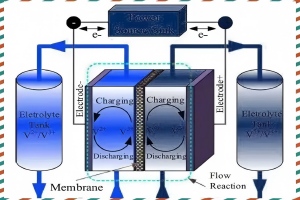
IEA forecasts global battery capacity will climb from 86 GW (2023) to 760-1,200 GW by 2030, and reach 2,000-3,500 GW by 2040, subject to policy frameworks.
By 2030, data centres will emerge as a major growth driver for global battery energy storage, accounting for 50 % of incremental power demand across the United States, per IEA projections. While not all data centres will run on renewables, large-scale Battery Energy-Storage Systems (BESS) will mitigate solar-and-wind intermittency, enabling data-centre operations powered by renewable power.
Within Australia, the Government of Western Australia has filed an application for a 50 MWh Vanadium BESS project valued at AUD 150 million (USD 105 million).
Although VRFB demand prospects look robust, it remains to be seen whether Australian producers can meet such demand at competitive price points without additional government support.
Price Assumptions & Industry Headwinds
In its feasibility study dated 20 July, CMG set V₂O₅ price assumptions of USD 5.90-8.70 per pound over the first 25-year mine-operation lifecycle.
By contrast, QEM adopted a price assumption of USD 11.56/lb in its 2024 scoping study, before announcing the project was no longer commercially viable in 2025.
These internal forecasts sit above Argus’ upper-end Rotterdam assessment for 98 % minimum molten-flake V2O₅, which stood at USD 5.50/lb on 28 July. The projections also far outstrip domestic ex-works and FOB prices for 98 %-grade V2O5, assessed flat at USD 5.00/lb and USD 5.15/lb respectively on 29 July.
Surging sulphuric-acid costs represent another material challenge for CMG. The company plans to procure one million tonnes of sulphuric acid annually, while also producing 3-4 million tonnes per year on-site by burning imported sulphur pellets. CMG states the project retains economic viability so long as sulphuric-acid price hikes do not exceed 20 %.
Driven by supply tightness stemming from US-Iran conflicts, Argus-assessed China FOB sulphuric-acid prices rocketed 178 % in June to USD 382.50/tonne. Prices subsequently eased to USD 345/tonne on 30 July amid broad weakening demand. Volatile sulphuric-acid prices will continue to pose risks for Australian vanadium-refining operations.
Substantial government backing will most likely be required for the domestic vanadium industry to scale up.
The Queensland Government has invested AUD 115 million into a common-user processing facility designed to de-risk projects and foster domestic refining, transforming Townsville into “a globally-competitive critical-minerals-processing hub”, Queensland Minister for Resources and Mines Dale Last told Argus on 18 July.
Queensland will inject an extra AUD 52.5 million into its critical-minerals sector for the 2026-27 fiscal year, Minister Last added, without disclosing specific project allocations.
Vanadium developers may rent access to this public facility by paying government royalties. Fees will be negotiated case-by-case based on utilisation intensity and remain commercially-confidential.
To date, Vecco is the sole vanadium producer that has signed-up for facility access. The other five Queensland-based vanadium developers have declined to comment on whether they intend to utilise the facility, and whether funding from the Queensland Critical Minerals Upscaling Fund (QRCUF) delivers sufficient state support for their operations.
Author: Daniel Gage-Brown



著作権 @ 2010-2026 UrbanMines Tech. Co., Ltd. 全著作権所有 .
 IPv6 サポートされているネットワーク